
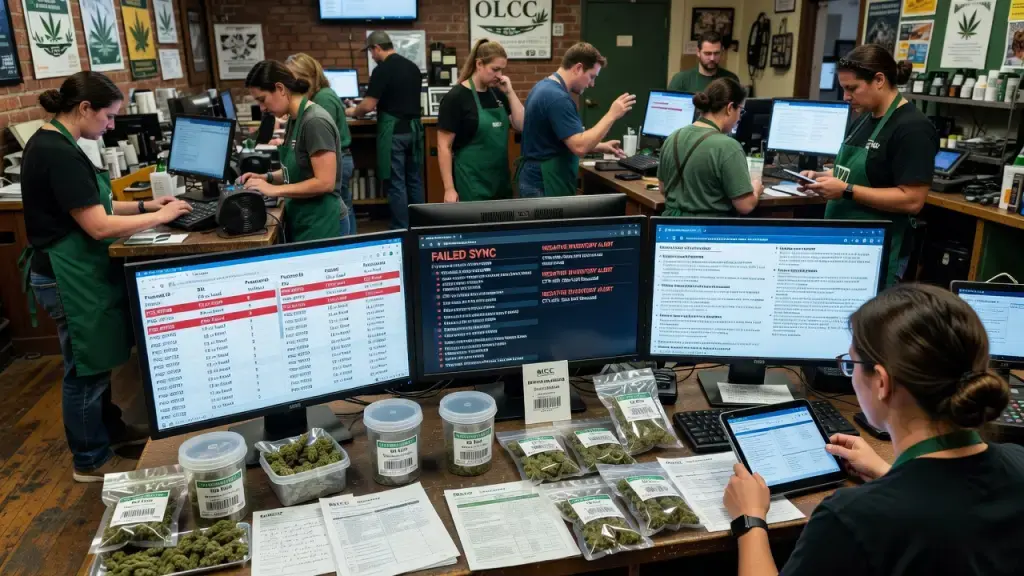
Every transaction at an Oregon dispensary touches two ledgers at once: the point-of-sale system and the state's Cannabis Tracking System, known to most operators as CTS or Metrc. Keep them aligned and the store runs quietly. Let them drift apart and budtenders end up doing inventory forensics instead of ringing up customers. The Oregon Liquor and Cannabis Commission requires recreational licensees and their staff to use CTS, and that obligation does not pause for a busy Friday or a short-staffed shift.
Small Mistakes, Not Big Scandals
Most Metrc discrepancies do not start with fraud or willful noncompliance. They start with ordinary retail friction - a budtender grabs the wrong package, a return gets processed differently than the last one, a sync job quietly fails in the background. Add in duplicate entries, mismatched product-to-package mapping, and inconsistent staff procedures, and a store can accumulate a pile of small errors that, left alone, becomes a real compliance headache. A connected point-of-sale system built for Oregon's regulatory environment can reduce the manual re-entry that causes many of these slips, but it does not replace the need for clean data and consistent habits.
Where Package Mapping Breaks Down
Package selection sounds simple until you watch it happen at volume. A retail product may be tied to a specific active Metrc package, and if an employee picks the wrong one, the sale still rings up fine at the register - the inventory just gets deducted from the wrong record. That gap often goes unnoticed until a reconciliation turns up numbers that do not add up. Verifying product name, SKU, package ID, quantity, and category at receiving is far cheaper than untangling weeks of mismatched transactions later.
Reconciliation Is the Real Compliance Engine
OLCC guidance calls for ongoing tracking and daily reconciliation, not an occasional cleanup pass. The useful exercise is comparing three sources: POS inventory, Metrc inventory, and physical count. When all three agree, confidence is earned, not assumed. When they diverge, the pattern itself is diagnostic - POS and physical matching but Metrc off points to a sync or reporting issue; Metrc and physical matching but POS off suggests a package-mapping problem; POS and Metrc matching but physical count off usually means shrinkage, miscounting, or unrecorded activity on the floor.
Forcing numbers to match without finding the cause just buries the next discrepancy a little deeper.
Procedure Beats Software, Most Days
Returns, voids, and failed submissions are where inconsistency tends to live. Employees may know how to reverse a sale at the register without understanding what that does to inventory records on the back end. Documenting who can authorize a return, how inventory gets restored, and who reviews unusual return activity matters more than any new software feature. The same goes for failed Metrc submissions - staff should confirm whether an original record exists before resending anything, since blind resubmission tends to create duplicates rather than fix the underlying problem.
- Standardize receiving checks: package IDs, quantities, labels, SKUs, categories, pricing
- Build exception reports for negative inventory, repeated voids, and failed syncs
- Keep physical counts on a regular schedule, independent of what software reports
- Align ecommerce inventory with in-store POS to prevent overselling
- Apply identical workflows across every location in a multi-store operation
What Operators Should Ask Before Buying
When evaluating a cannabis POS, the integration claim is the easy part - ask to see how a failed submission actually looks on screen, how a package mismatch gets flagged, and how a manager reviews an unusual adjustment. A system that smooths over exceptions instead of surfacing them can create more exposure, not less. Reliable technology, trained staff, accurate mappings, and daily reconciliation work together; none of them substitutes for the others. For Oregon retailers, the payoff for getting this right is not faster paperwork - it is inventory data that holds up from the moment a package arrives until the sale is final.