The DEA's move to reschedule marijuana from Schedule I to Schedule III is the most significant shift in federal cannabis policy in decades - and the industry is right to acknowledge it. But there's a meaningful difference between a regulatory milestone and an open market, and right now, that distinction matters enormously for investors watching Canadian cannabis companies position themselves for a U.S. push that may be much further off than the press releases suggest.
What Rescheduling Actually Changes - and What It Doesn't
Schedule III status acknowledges that marijuana has accepted medical uses and a lower potential for abuse compared to Schedule I substances. That has real consequences: it opens more doors for clinical research, it eases some institutional banking restrictions on licensed medical cannabis businesses operating within compliant state frameworks, and it signals a softening of federal posture. For U.S.-licensed operators running dispensaries under state medical programs, those are tangible operational improvements.
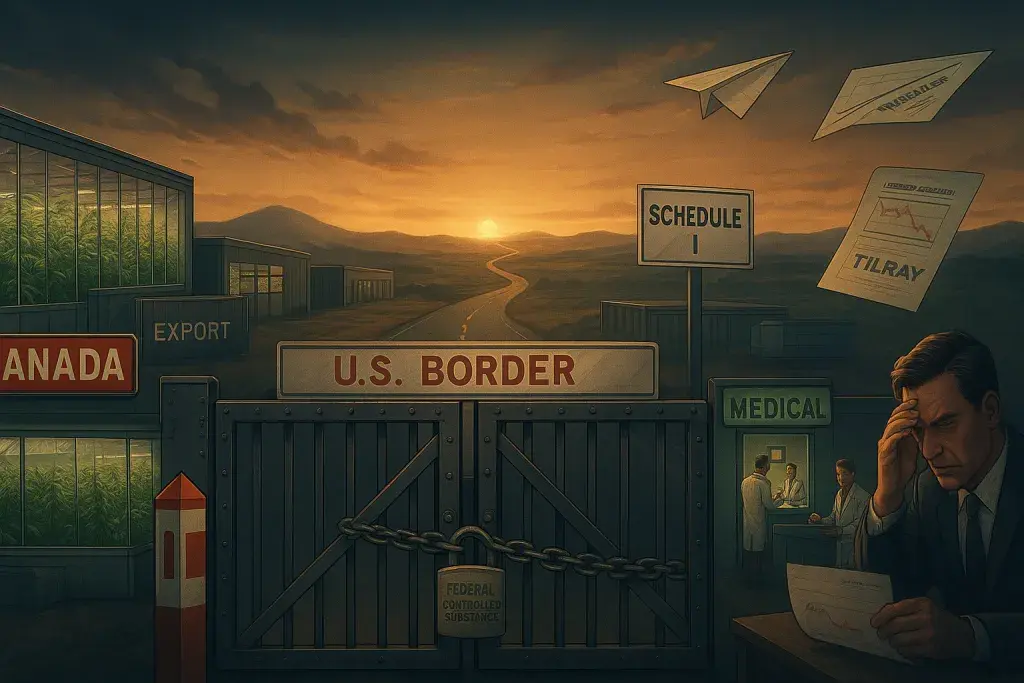
Here's the catch, though. Rescheduling is not legalization. Marijuana remains a federally controlled substance. The international border - governed by federal law on both sides - stays closed to commercial cannabis movement. A Canadian licensed producer cannot ship cannabis products into U.S. dispensary supply chains simply because the DEA moved marijuana down a scheduling tier. The regulatory infrastructure for cross-border cannabis commerce doesn't exist, and rescheduling does nothing to create it. Recreational cannabis products haven't been rescheduled at all.
To put it plainly: rescheduling changes what U.S. researchers can do with marijuana and what licensed medical businesses can do within existing state frameworks. It does not change what Tilray or any other foreign-licensed producer can do at the U.S. border.
The Gap Between a Press Release and a Market Entry
Tilray Brands moved quickly after the rescheduling announcement, describing itself as "positioned for U.S. expansion" and calling the federal action "a defining inflection point." That language is aimed squarely at investors, and there's nothing wrong with a publicly traded company communicating optimism. But operators and investors should read those statements carefully.
Being positioned for an opportunity is not the same as having that opportunity available. Tilray holds a strong production infrastructure and has been building U.S. market adjacencies - including its beer and beverage portfolio - but legal cannabis distribution into U.S. dispensary wholesale channels requires federal legalization or, at minimum, a federal licensing framework that currently does not exist. That process, even if it began tomorrow under favorable political conditions, would take years. Government scheduling reform from initial review to final rule has historically moved slowly; the rescheduling process that just concluded began with a formal request in October 2022.
The Trump administration has not signaled broad legalization as a near-term legislative priority. Even optimistic timelines for federal adult-use reform run years out. And until recreational cannabis is rescheduled or legalized at the federal level, the commercial aperture for a Canadian producer entering that market remains effectively shut.
A Familiar Pattern That Has Burned Investors Before
This is not the first time cannabis investors have priced in a regulatory catalyst before it materialized. The pattern has repeated - policy optimism drives stock appreciation, reform stalls or underwhelms, prices correct - and Tilray's own trading history makes that visible. The stock's last meaningfully positive annual return came in 2018, tied directly to Canada's national legalization. Since then, the company's share price has deteriorated substantially, even as the underlying Canadian cannabis market matured.
What's striking here is that the market intelligence required to assess this situation is not obscure. The mechanics of federal scheduling law, the structure of the Controlled Substances Act, and the regulatory steps required for international cannabis commerce are all documented and publicly accessible. The risk isn't that investors lack information - it's that optimistic corporate messaging around policy milestones can make a partial change feel like a complete one.
For dispensary operators, wholesalers, and supply chain vendors in the U.S., the rescheduling news is legitimately positive: it eases research pathways, may soften some compliance friction around medical programs, and represents a long-overdue federal acknowledgment that cannabis has medical value. For Canadian producers eyeing U.S. market entry, the situation is more nuanced. The door has moved slightly; it has not opened.
What the Industry Should Actually Watch
Meaningful signals for U.S. market entry by foreign licensed producers would include federal adult-use legalization, passage of the SAFE Banking Act or equivalent legislation enabling true interstate commerce, or a formal federal licensing structure for cannabis imports. None of those are in place. Progress on any of them would be worth tracking closely.
Until then, the more productive question for operators and investors alike isn't whether Canadian producers are positioned for U.S. expansion. It's what conditions would actually have to be true before that expansion becomes legally executable - and how far those conditions are from the current regulatory reality. The honest answer is that they remain considerable distance away. Rescheduling is a step. It isn't an arrival.