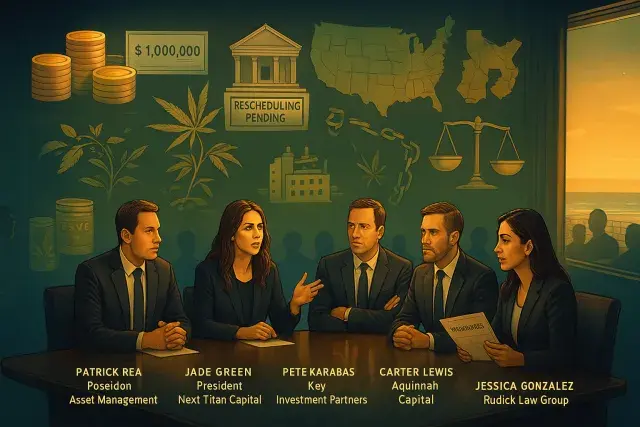
At MJ Unpacked in Atlantic City, the question operators kept asking wasn't about product, branding, or even operations - it was simpler than that: where is the money, and when does it come back? Investors who took the stage were candid. Capital is out there, but the conditions that would unlock it at scale haven't fully arrived yet. Federal rescheduling has moved the needle, drawing new outside attention to the sector, but it hasn't solved the deeper structural problems that have kept institutional money largely on the sidelines.
The panel, led by Patrick Rea of Poseidon Asset Management, surfaced something operators in states like New Jersey already feel acutely - cannabis remains a hyper-fragmented industry where scaling across state lines is expensive, operationally complex, and legally treacherous. For operators in newer adult-use markets who have invested heavily in infrastructure, from cannabis pos maryland-style retail systems to compliant packaging lines and seed-to-sale tracking integrations, the question of whether outside capital will follow that investment is not abstract. It's a survival question.
Jade Green, President of Next Titan Capital, made a point that deserves more attention than it usually gets: most operators don't fully understand what kind of capital their business is actually suited for. Debt versus equity isn't just a financing preference - it's a structural decision that determines how a company grows, who controls it, and what obligations it carries. While more banks and credit unions are beginning to enter the cannabis space, debt remains expensive and hard to secure. Lenders still expect real estate, personal guarantees, strong sponsorship, or documented cash flow. Startups without those assets are essentially disqualified from most traditional debt products. Family-and-friends capital and strategic partnerships remain the realistic starting point for many early-stage operators.
Why Institutional Capital Hasn't Moved
Pete Karabas of Key Investment Partners offered a sobering reality check. Much of the capital that flowed into cannabis over the past five years has not yet produced meaningful returns. That money isn't gone - but it's tied up, and investors waiting on exits before redeploying can't simply write new checks. That dynamic has a compounding effect on the whole ecosystem: less recycled capital means fewer new deals, and fewer new deals mean less price discovery and fewer benchmarks for future investors to evaluate.
Green added that mainstream U.S. institutional investors remain largely absent. What her firm is seeing instead is interest from Canadian operators and other international players who want U.S. market exposure. Big Alcohol, Big Tobacco, and Big Pharma - the so-called "big guys" that cannabis watchers have anticipated for years - are still watching rather than moving. Their hesitation isn't irrational. State-by-state fragmentation means a national cannabis brand still can't function the way a national beverage brand does. There's no interstate commerce in plant-touching products. Every state is effectively a separate market with its own licensing regime, tax structure, compliance calendar, and operational requirements. Until that changes, large corporate acquirers face a consolidation math problem that doesn't pencil out cleanly.
That said, the strategic attention is real. Consumer behavior around alcohol is shifting, and both beverage and tobacco companies are watching cannabis closely enough that when federal conditions improve, they'll be positioned to move quickly. The operators who build scalable, replicable systems now - consistent product quality across markets, clean compliance records, defensible brand identity - are the ones most likely to be attractive targets when that moment arrives.
What Investors Are Actually Looking For
Karabas was direct about his firm's evaluation framework: revenue matters, but the more important signal is whether a company has actually demonstrated it can scale. Can the business replicate its model in a new state without falling apart operationally? Does the product stay consistent across facilities and regulatory environments? Is there a repeatable system behind the brand, or is success tied to one strong personality and one favorable market? Those aren't rhetorical questions - they're the filter that separates investable companies from interesting ones.
Carter Lewis of Aquinnah Capital pushed founders to think even earlier in the process. Building with a specific exit in mind changes the decisions you make along the way - which markets you enter, which partnerships you form, which compliance infrastructure you invest in. If a likely future acquirer is a regional MSO that values operational efficiency and strong POS data, that should inform how you build your systems today. If the likely buyer is a consumer packaged goods company that values brand equity and trademark portfolios, your intellectual property strategy becomes a business priority, not a legal afterthought.
Hemp's Uncertain Position and the Dual Licensure Opportunity
The panel also tackled a growing strategic question for hemp-derived beverage operators: what's the contingency plan if the regulatory ground shifts? Rea posed a pointed scenario - what if a hemp beverage company with strong brand recognition and meaningful distribution decided to pursue medical marijuana processing licenses as a hedge against future regulatory disruption? Karabas acknowledged the risk involved in that strategy, but also the logic of it. If hemp carveouts narrow or state-level crackdowns on intoxicating hemp products accelerate, operators may find that cannabis licensure isn't a growth strategy - it's a survival plan.
Lewis made the case that a profitable hemp brand with proven consumer traction could actually be a more compelling investment if it successfully transitions into a licensed marijuana model. The brand equity is already built. The consumer relationship already exists. What changes is the regulatory structure underneath it - and in some respects, that's a more stable foundation than a market that remains in legal ambiguity at the federal level.
Rea also highlighted dual licensure as a potentially significant unlock for existing operators. In many markets, adult-use licensees are excluded from the tax treatment available to medical cannabis businesses, including 280E relief structures that may accompany certain medical designations. Expanding access to dual licensure - where operators can participate in both medical and adult-use channels - could improve margins and reduce tax exposure in meaningful ways. That's not a minor operational footnote; for operators already squeezed by high excise taxes and cost-of-goods pressure, it's the kind of structural change that could determine whether a business is viable at all.
IP Strategy Isn't Optional if You Plan to Scale
Jessica Gonzalez of Rudick Law Group brought a different but complementary angle to the conversation. While investors were discussing capital deployment, Gonzalez focused on what operators need to do right now to make themselves worth investing in later. Her message: treat your trademark portfolio as an appreciating asset, not a legal compliance item.
Many cannabis operators still rely on common law trademark protections, which offer limited coverage and don't travel well across state lines - a serious problem for any brand planning to license, expand, or eventually be acquired. Gonzalez urged operators to build trademark portfolios around adjacent goods and services, not just plant-touching products, to capture protections that current federal law may allow even while cannabis itself remains in a complicated legal category. Logos, trade dress, website assets, formulations, and trade secrets all have potential value that doesn't depreciate the way equipment or buildout costs do.
She also suggested a practical hedge for hemp beverage companies facing regulatory uncertainty: proactively launching CBD versions of their brands to maintain consumer awareness and build trademark use records while the intoxicating hemp question gets resolved. That's not a pivot - it's a way to keep the brand alive and legally active across a wider surface area while the rules catch up.
The investors in Atlantic City may still be waiting. But the operators who come out of this period with clean compliance records, scalable operational systems, and defensible intellectual property will be in a materially different position than those who waited too. The capital will move eventually. The question is whether your business is built to receive it.