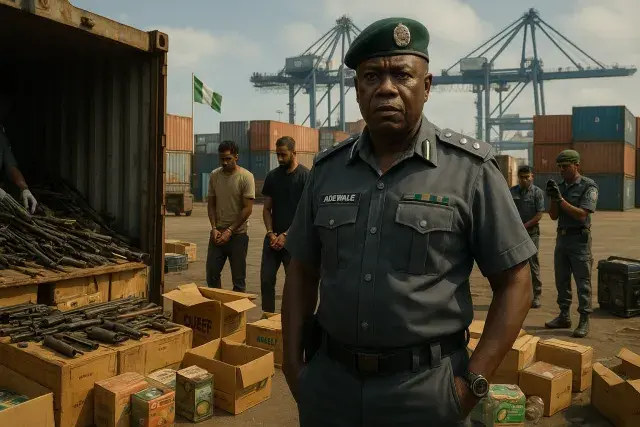
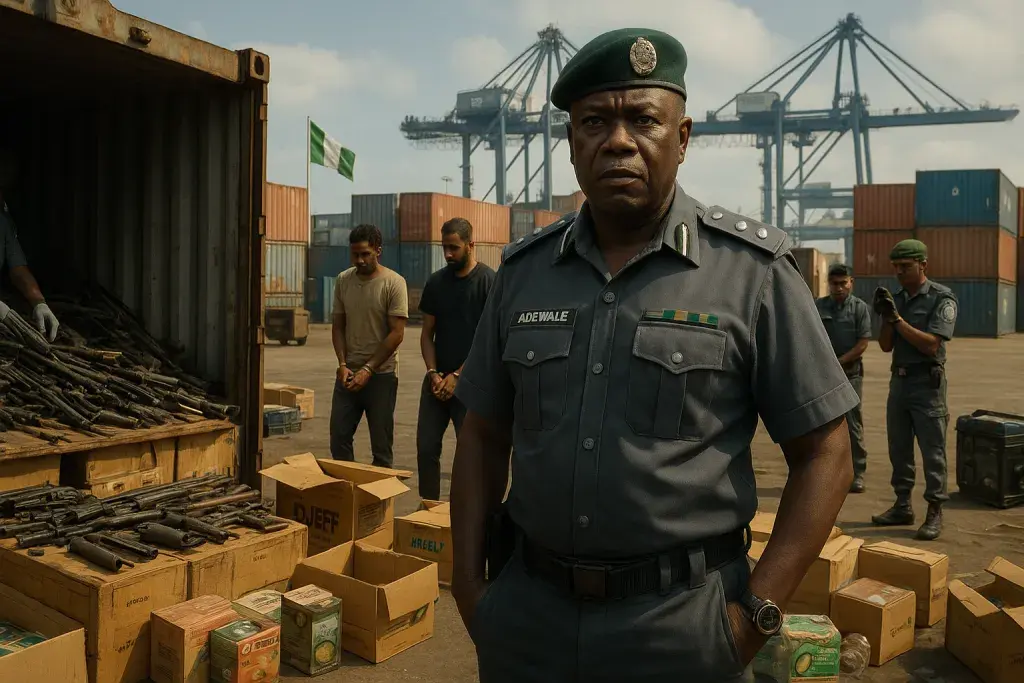
Nigerian Customs officials at Tincan Island Port disclosed the interception of a shipping container hiding components for more than 140 pump-action rifles, alongside a separate seizure of cannabis-infused products valued at over ₦373.8 million. The announcement, made by Comptroller General of Customs Adewale Adeniyi on 6 August 2026, points to a pattern federal officials describe as an escalation in trafficking attempts routed through legitimate import channels.
For operators across regulated markets who watch import enforcement trends, cases like this one are a reminder that customs risk profiling and inventory reconciliation are not abstractions - they are the backbone of legal supply chains. In jurisdictions where cannabis commerce is licensed, similar rigor applies downstream at retail: batch tracking, manifest verification and point-of-sale reconciliation all exist to keep unauthorized product out of the legal stream. Dispensary operators managing that chain of custody often rely on systems such as POS built for cannabis to log every transaction against verified inventory, which is precisely the kind of traceability absent in the smuggling routes Nigerian Customs says it disrupted.
What the Seizure Signals for Cross-Border Enforcement
According to Adeniyi, the container carrying the rifle components arrived aboard MV VELIKA on 8 July 2026 and was flagged through the Service's intelligence-driven risk management system before physical inspection confirmed knocked-down parts preliminarily identified as JoJeff pump-action rifles. Two suspects have been arrested; a third remains at large. In a separate operation, two 40-foot containers were found carrying cannabis-infused cookies, gummies and pre-roll products concealed among used vehicles, generators and batteries - goods chosen, investigators suggest, precisely because they draw less scrutiny at the point of entry.
The breakdown of the cannabis seizure - 109 cartons of Delta-8 pre-roll cookies, 125 cartons of Delta-8 gummies and 73 cartons of infused cookies - illustrates a tactic common to illicit trafficking networks worldwide: burying regulated or prohibited goods inside high-volume, low-suspicion cargo. It is a method that stresses customs agencies everywhere, not just in Nigeria, because container volume vastly outpaces the manpower available for manual inspection.
Compliance Lessons Beyond Nigeria's Borders
Nigeria does not currently operate a legal adult-use or medical cannabis retail market comparable to those in North America, which makes any cannabis product entering the country through undeclared channels a straightforward violation rather than a regulatory gray area. That distinction matters for operators in licensed markets abroad: it underscores why compliant packaging, lab testing and certificate-of-analysis documentation exist - not as bureaucratic overhead, but as the paper trail that separates a lawful supply chain from a smuggling operation. Products without verified COAs, batch numbers or manifest documentation cannot legally move through licensed wholesale or retail channels in regulated states, and this case is a blunt illustration of what happens when that documentation is absent entirely.
Election-Season Risk and Institutional Accountability
Adeniyi's warning about the coming election cycle reflects a recurring concern among security agencies: that periods of political transition create openings for smuggling networks to move contraband, including weapons, with reduced scrutiny. He also addressed internal risk directly, stating the Service would not tolerate personnel acting as accomplices to import fraud. For any regulated industry - cannabis included - insider compromise at logistics or licensing checkpoints is often a bigger vulnerability than external smuggling attempts, and Adeniyi's comments suggest Customs leadership is treating that risk as a genuine institutional threat rather than a hypothetical one.
The Comptroller General credited officers at Tincan Island and the Customs Enforcement Unit for the interceptions and reiterated a call for public intelligence tips. Whether the investigation yields further arrests of the network's organizers remains an open question, and one worth tracking for anyone monitoring how customs enforcement intersects with cannabis product movement in markets still defining their regulatory posture.