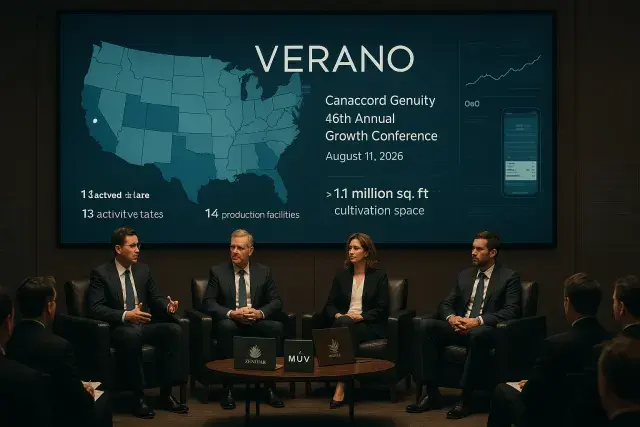
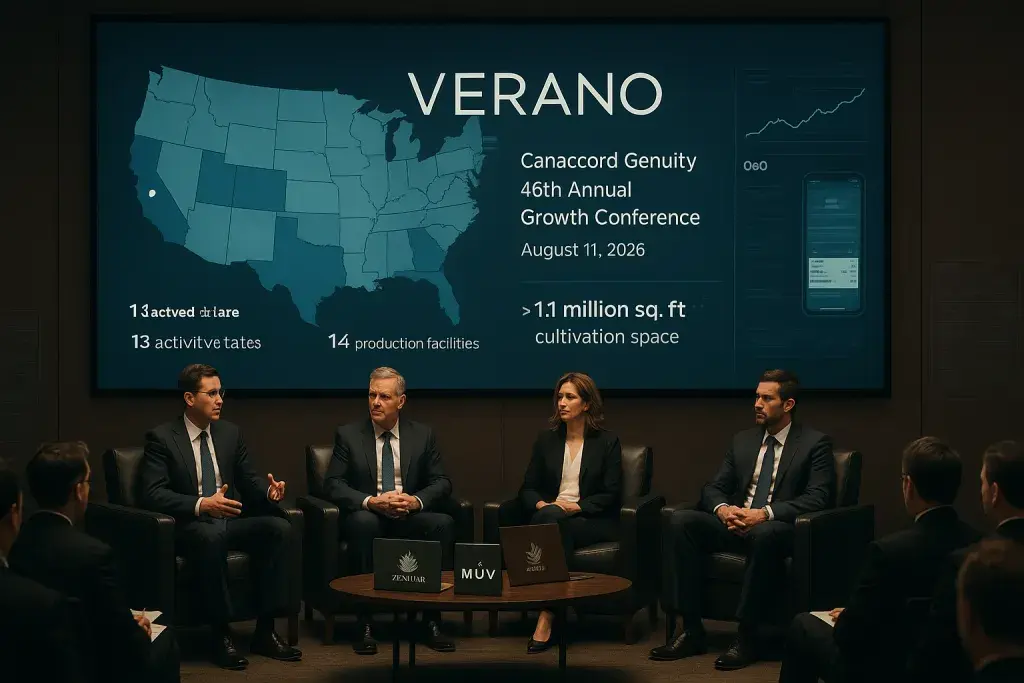
Verano Holdings Corp. confirmed that its executive leadership team will appear at the Canaccord Genuity 46th Annual Growth Conference in Boston on August 11, 2026, participating in a fireside chat and a round of investor meetings. For a multi-state operator running dispensaries under the Zen Leaf and MÜV banners, this kind of appearance is less about splash and more about maintenance - keeping analysts and institutional holders current on operational performance at a time when capital access for plant-touching companies remains tighter than most sectors of comparable size.
That distinction matters more than it might seem. Cannabis multi-state operators still can't list on major U.S. exchanges, still face 280E tax exposure that erodes net margins even when gross revenue looks healthy, and still rely heavily on OTCQX and Canadian listings, as Verano does with its dual Cboe CA and OTCQX designation, to reach investors at all. Fireside chats at growth conferences function as a substitute for the kind of routine institutional access that companies in other retail categories take for granted. Behind the investor-facing narrative, though, the operational backbone of a company like Verano depends on far less glamorous infrastructure - cultivation facilities, wholesale distribution, and store-level systems that keep every SKU traceable from seed to sale. In markets like California, that traceability runs through platforms such as Metrc-compliant POS for California, which link dispensary transactions directly to state tracking requirements and give operators the audit trail regulators now expect as a baseline, not an option. Metrc-compliant POS for California
Why Investor Visibility Still Matters for MSOs
Multi-state cannabis operators live under a strange contradiction: they generate real revenue in regulated markets, yet remain shut out of the banking and capital markets access that ordinary retailers use to fund expansion. Conferences like Canaccord's Growth Conference give executives a chance to explain how they're managing store footprints, cultivation capacity, and brand portfolios across state lines with fragmented regulatory frameworks in each jurisdiction. Verano's active footprint across 13 states, supported by 14 production facilities and more than 1.1 million square feet of cultivation space, is the kind of operational scale that investors want contextualized in person rather than parsed from a filing alone.
The Compliance Layer Behind the Investor Pitch
What's striking here is how much investor confidence in an MSO actually rests on backend compliance discipline rather than storefront appeal. Seed-to-sale tracking, accurate COAs from lab testing, and clean compliance logs aren't just regulatory checkboxes - they're the operational proof points that support the growth story executives present to analysts. A dispensary chain with strong same-store performance but shaky inventory reconciliation or inconsistent METRC reporting is a liability dressed up as an asset. Investors evaluating cannabis equities have learned to ask not just about revenue, but about how disciplined the compliance infrastructure is beneath it.
What Operators Should Take From This
Smaller operators watching a company like Verano court institutional investors should read this less as competitive noise and more as a signal about where the industry's credibility bar sits. Wholesale partners, landlords evaluating retail leases, and payment providers assessing risk all watch how MSOs communicate financial discipline publicly. A polished investor conference appearance doesn't replace fundamentals, but it does reinforce a market expectation: that survival in this business now depends as much on financial transparency and compliance rigor as it does on square footage or brand recognition.