Missouri's regulated cannabis market is doing what state regulators hoped it would do: pulling consumer dollars away from illicit sellers and keeping them inside licensed storefronts. A new Phase 1 report from Cannabis Public Policy Consulting (CPPC), prepared for the Missouri Department of Health and Senior Services' Division of Cannabis Regulation, finds that roughly 93% of reported cannabis expenditures in the state now flow through regulated dispensaries. That's a notable figure for a market still working out licensing structure, tax policy, and retail saturation questions three years into adult-use sales.
Why Market Concentration Matters to Regulators
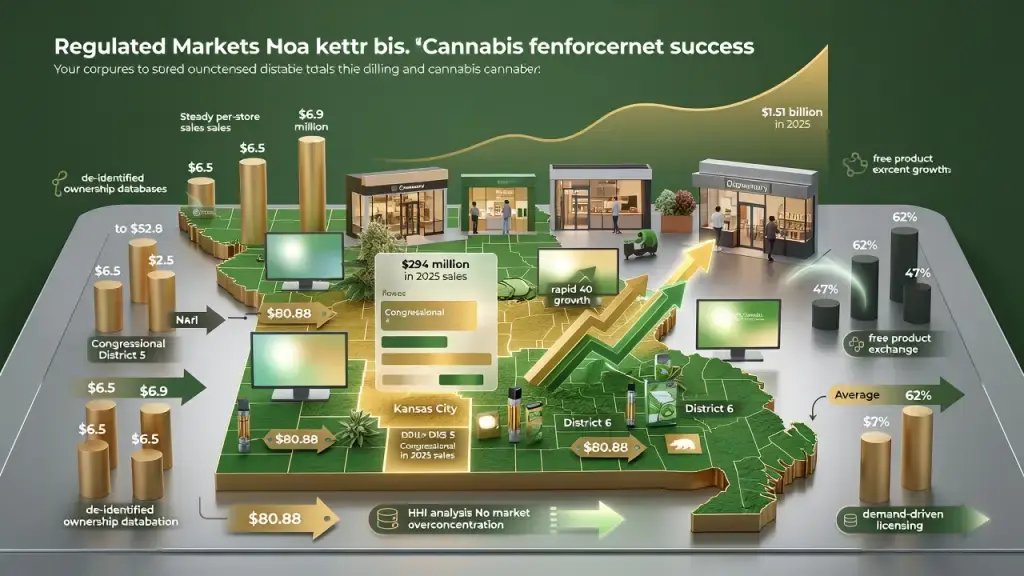
The study, led by principal investigator Gideon Cunningham, PhD, with co-investigator Mackenzie Slade, MPH, and analysts Summer Fox, MPP, and Mimosa Khatun, PhD, combined a survey of 1,200 past-month consumers with 35 months of track-and-trace data, licensing records, and demographic figures. One of its central questions: is Missouri's dispensary network too concentrated in the hands of a few operators, and does that concentration push consumers toward unregulated sellers? The answer, based on Herfindahl-Hirschman Index analysis across all eight congressional districts, is no. HHI values came in well below the thresholds economists typically associate with concentrated markets - a finding that should ease concerns among smaller operators worried about getting squeezed out by larger multi-license holders.
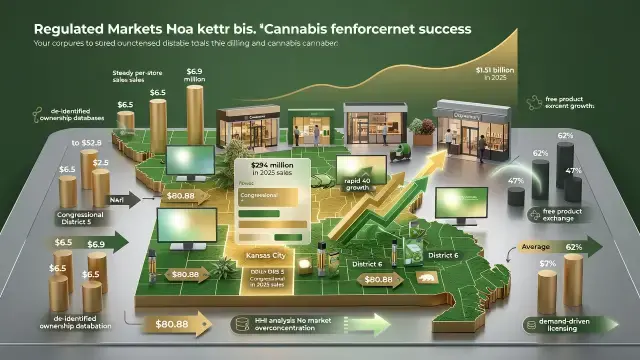
That matters for licensing policy going forward. Congressional District 5, covering the Kansas City area, generated the highest dispensary sales in the state, reaching approximately $294 million in 2025, while District 6 posted the fastest growth, with sales climbing nearly 40% over three years. Statewide dispensary sales rose from about $1.30 billion in 2023 to $1.51 billion in 2025, yet average sales per store held steady in the $6.5 to $6.9 million range - a sign that growth came from expanding consumer participation rather than from a handful of stores pulling away from the pack.
What's Actually Driving Illicit Purchases
Here's the part that should reshape how regulators think about enforcement. Multilevel modeling in the report found no significant relationship between dispensary market concentration and purchasing outside the regulated system. In other words, consolidation isn't what's pushing people toward unlicensed sellers. Price is. Among consumers who reported buying illicit product, 62% cited lower prices as the primary driver, and not a single respondent pointed to a lack of adult-use dispensary access. Price ranked as the top purchasing consideration overall, cited by 66% of consumers, ahead of THC potency at 58% and convenience at 40%. Legal status barely registered as a factor.
For operators, that's a pricing and competitiveness problem, not a zoning or saturation problem. Wholesale pricing pressure, excise tax burden, and 280E-driven overhead all feed into shelf prices that compete directly with an unregulated market carrying none of that cost structure. Compliance costs aren't going away, but the data suggests the real competitive fight is happening at the register, not in license allocation maps.
Spending Patterns and Informal Distribution
Flower remains the backbone of retail spending, averaging $80.88 per consumer monthly, with vape products at $28.40 and edibles at $25.69. Medical patients consistently outspend adult-use consumers across categories - $96.00 versus $76.70 on flower, and a wider gap on edibles at $45.61 versus $20.19 - a pattern that reinforces the importance of medical access programs even in mature adult-use states.
One finding deserves attention from compliance teams and policymakers alike: 47% of consumers report receiving cannabis for free at least sometimes, and more than half of those who got product through friends or family say it originated at a licensed dispensary. That's informal redistribution of legally purchased product, not diversion from illicit channels, but it complicates how regulators measure true market capture. CPPC recommends further research here rather than immediate rule changes.
Policy Direction and Alternative Cannabinoids
CPPC's recommendations lean toward refinement rather than overhaul. The report suggests building a de-identified ownership database to strengthen facility-level HHI analysis, and questions whether the current congressional district-based license allocation model should give way to demand-driven geographic distribution - a shift that could matter considerably for operators eyeing expansion or new license applications.
On alternative cannabinoids, the report counsels against additional regulatory action for now. THCA posted the highest past-month use among alternative cannabinoids at 15%, outpacing several traditional categories including concentrates and beverages, but outside of CBD and THCA, use remains low enough that CPPC sees no urgent compliance gap to close.
- 93% of reported spending flows through regulated dispensaries
- HHI analysis shows no overconcentration in any congressional district
- Price, not access or legal status, drives illicit purchasing behavior
- 47% of consumers report receiving cannabis for free at least sometimes