
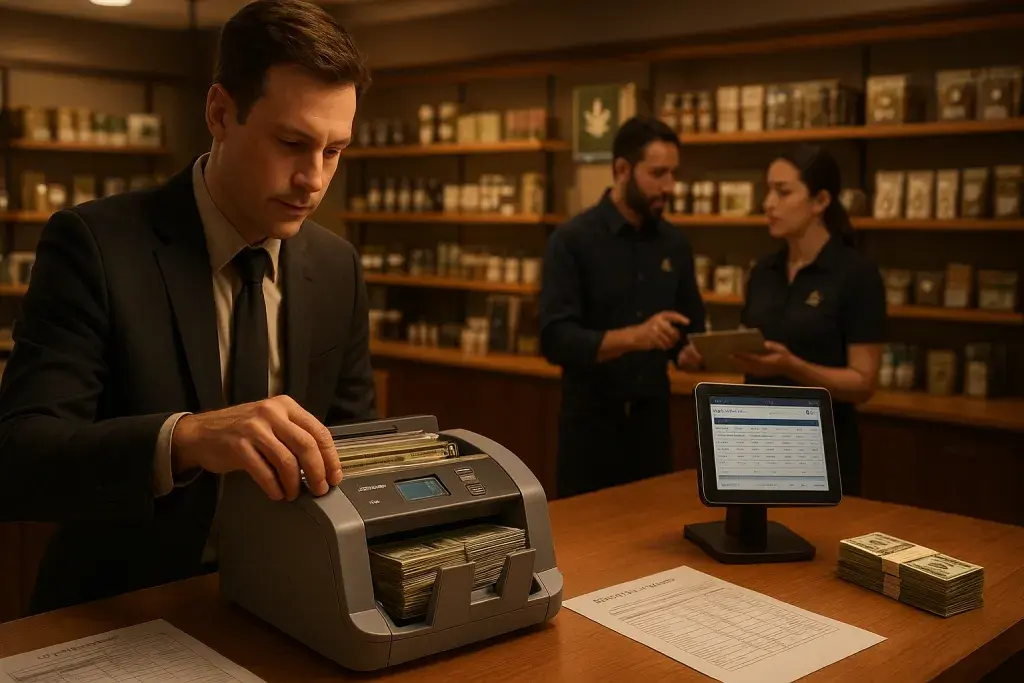
For licensed cannabis retailers, the end-of-day closeout is no longer a back-office afterthought - it is one of the most operationally consequential workflows in the building. As daily cash volumes rise alongside transaction counts, the gap between a standardized reconciliation process and an improvised one translates directly into discrepancies, audit exposure, and management drag. According to AccuBANKER, a commercial cash-handling solutions provider with more than four decades of industry experience, dispensaries that formalize their closeout procedures consistently reduce both reconciliation time and administrative burden.
The pressure is structural. Most licensed dispensaries still operate in predominantly cash-based environments - a reality shaped by federal banking constraints that limit access to conventional merchant services. Industry organizations have documented that cash accounts for a substantial majority of cannabis retail transactions, meaning operators count, verify, and reconcile large volumes of physical currency every single business day. That operational reality is not unique to any one state market, though operators working with solutions like IndicaOnline in Arizona are among those building the kind of integrated POS and reporting infrastructure that makes standardized closeout workflows more achievable at scale. Small inefficiencies during that daily process - a miscounted drawer, an undocumented variance, a batch skipped during verification - compound fast when transaction volume is high.
The American Bankers Association has noted repeatedly that federal banking restrictions push cannabis businesses toward unusually rigorous internal cash controls, effectively requiring operators to function more like armored carriers than conventional retailers. Federal Reserve guidance on currency handling reinforces the underlying point: accuracy and consistency in physical cash processing are foundational to sound financial reporting. For cannabis operators managing seed-to-sale tracking obligations, METRC reporting requirements, and state-level audit exposure, that principle carries added weight. A discrepancy in the cash drawer that goes unresolved at closeout does not stay contained - it creates a downstream problem in inventory reconciliation, excise tax reporting, and compliance documentation.
What a Standardized Closeout Actually Requires
The objective of a strong closeout is a repeatable process, not simply a faster count. That distinction matters. Speed is a byproduct; the real deliverable is documented accuracy. A well-constructed end-of-day procedure typically sequences through drawer pulls by POS terminal, batch verification of currency by denomination, counterfeit detection, variance documentation, printed or digitally archived reconciliation reports, and a management sign-off that creates a clear accountability trail. When those steps happen in the same order, by the same method, every night, variances become easier to isolate - and easier to explain to auditors, compliance officers, or investors.
Commercial cash-handling systems accelerate this by automating the counting, sorting, and reporting functions that consume the most time in manual closeouts. Automated currency counters with counterfeit detection reduce the error rate on denomination verification. Batch reporting tied to individual drawers creates a per-register record rather than a single end-of-night aggregate. Printed documentation gives managers a physical audit trail without requiring additional data entry. None of these tools eliminate the need for human oversight - they structure and support it.
The Bottleneck That Grows With Volume
Here is the catch: manual closeout procedures that function adequately at low volume tend to break down as transaction counts rise. A dispensary processing a modest daily count of cash transactions can absorb the inefficiency of a semi-standardized closeout. A high-volume adult-use retailer moving several hundred transactions a day in a competitive urban market cannot. At that scale, an unstructured closeout becomes the single largest operational bottleneck at the end of every shift - tying up management attention, extending labor costs past posted hours, and generating reconciliation backlogs that carry into the next business day.
This is where the economics of standardization become concrete. Reducing closeout time by a meaningful margin across multiple shifts and multiple locations does not just save minutes - it reduces overtime exposure, frees managers for supervisory functions that require judgment, and compresses the window during which unresolved variances can create compliance risk. For multi-state operators managing dozens of licensed locations, that efficiency differential is measurable at the P&L level.
Multi-Location Expansion Depends on Repeatable Workflows
Consistent, documented closeout procedures also solve a problem that grows more acute as operators scale: staff onboarding and institutional knowledge transfer. When the closeout process lives in the habits of a long-tenured shift lead rather than in a written, trained workflow, turnover creates operational fragility. A new budtender or assistant manager stepping into a closing role needs a procedure, not tribal knowledge. Standardized workflows with clear documentation and commercial tools that produce consistent outputs make that transition materially faster and less risky.
For operators with multi-location ambitions - regional chains, vertically integrated multi-state operators, or social equity licensees expanding beyond their flagship store - this is not an abstract benefit. Auditors expect consistent internal controls across locations. Investors performing due diligence look for operational replicability. State regulators examining cash handling practices want evidence of systemic accountability, not anecdote. A standardized end-of-day reconciliation process provides all three audiences with something they can evaluate. That is the real return on the investment - not the faster count, but the defensible record it produces.