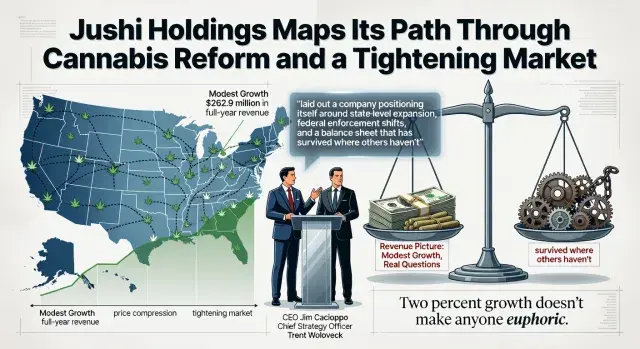
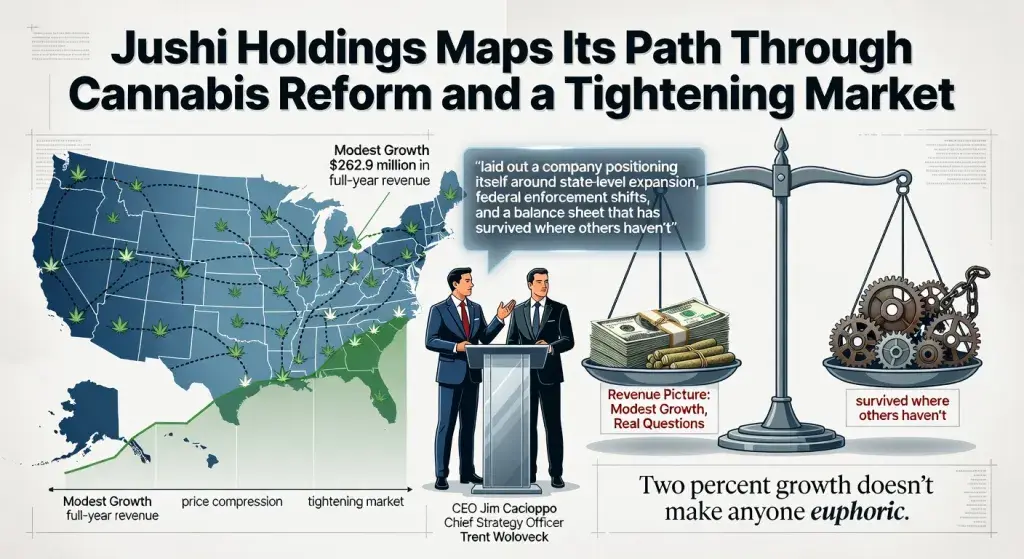
Jushi Holdings posted $262.9 million in full-year revenue, a modest two percent year-over-year gain in an industry still grinding through price compression. But the numbers are only part of the story. On the latest episode of the Trade To Black podcast, CEO Jim Cacioppo and Chief Strategy Officer Trent Woloveck laid out a company positioning itself around state-level expansion, federal enforcement shifts, and a balance sheet that has survived where others haven't.
The Revenue Picture: Modest Growth, Real Questions
Two percent growth doesn't make anyone euphoric. Cacioppo acknowledged as much, attributing a sequential dip in gross margins to a combination of holiday promotional pricing and a production overage in Q3 that forced the company to pull back output. The thing is, the adjusted EBITDA margin still expanded - to 20.4 percent - which suggests that underneath the top-line grind, operational discipline is tightening. Whether that margin holds through what's coming next is the open question.
Cacioppo was direct about the states he's watching. Virginia, where Jushi holds exclusive retail rights in the Northern Virginia corridor - roughly a third of the state's population - is the near-term catalyst. The company is scaling cultivation capacity ahead of the adult-use launch there. Pennsylvania, meanwhile, he described not as a slow ramp but as a future "boom," a market that could unlock rapidly once regulatory conditions shift. Two very different timelines. Two different bets.
Balance Sheet Survival as a Competitive Moat
The cannabis industry has not been kind to capital structures. Cacioppo pointed to the collapses of AYR Wellness and the former Columbia Care as cautionary examples - companies that once looked formidable and are now either restructured or gone. His argument: Jushi's more conservative capital approach is what kept it standing. To back that up with something beyond rhetoric, he disclosed a personal $28 million investment in the company's recently completed refinancing. He framed it less as a vote of confidence and more as a genuinely attractive deal given his existing equity position and the income it generates. Fair enough - but skin in the game at that scale does concentrate the mind.
Inside the White House Meetings on Hemp and Enforcement
This is where the conversation shifted from company-specific to industry-defining. Woloveck described attending closed-door sessions at the White House's Office of Information and Regulatory Affairs and the FDA, focused on cannabinoid enforcement policy ahead of the Farm Bill's November implementation date. His characterization was striking: these were the most substantive federal conversations he'd experienced in his career. Not debates. Fact-finding. Officials were asking precise, clarifying questions - specifically about the distinction between state-regulated cannabis products and intoxicating hemp-derived compounds flooding the consumer market with minimal oversight.
Woloveck also detailed Jushi's litigation strategy against hemp operators selling intoxicating products outside state-regulated frameworks. One defendant, he noted, had already settled across eight states and agreed to disgorge all profits. He was careful to add that outcome isn't representative - most cases won't resolve that cleanly. But the signal matters: licensed operators are not waiting for federal enforcement to catch up. They're going after unregulated competitors directly.
The Hemp Ban, Schedule III, and What Actually Happens Next
Speculation has circled for months that Congress might delay the ban on intoxicating hemp-derived THC products. Woloveck dismissed this flatly. The ban, he said, is already law. The November effective date is set. Senate attempts to block it failed decisively. In his view, there is no meaningful political will to extend what he characterized - without hedging - as a public health crisis. Strong language. But it tracks with the broader regulatory mood: the FDA's interest in these meetings suggests an agency preparing to act, not one looking for reasons to defer.
How all of this connects to potential Schedule III rescheduling remains genuinely uncertain. But the enforcement architecture is forming - and companies like Jushi, already operating within state-regulated systems, stand to benefit if federal policy draws a harder line between licensed cannabis and the unregulated hemp market. That's the bet. Whether the federal government follows through with the kind of enforcement muscle these policies demand is, as always, the part no one can predict with confidence.