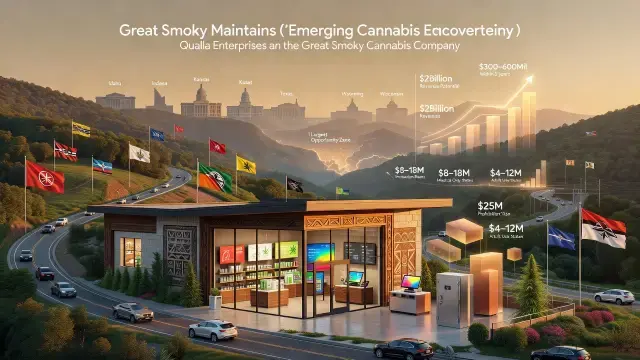
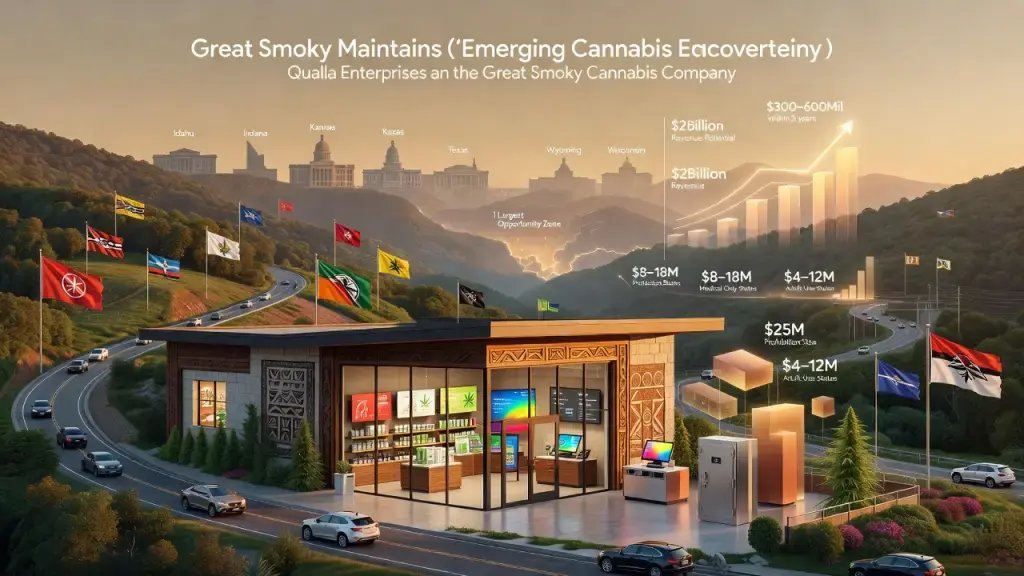
Native American tribes could generate more than $2 billion a year in new cannabis revenue by building regulated marketplaces on sovereign land, according to a new analysis from HedgeRow Analysis. The firm says tribes that act "deliberately and early" could see $300 million to $600 million annually within five years, scaling toward that $2 billion ceiling as federal legalization continues to stall and state-level reform slows to a crawl.
The opportunity, as HedgeRow frames it, rests on a simple structural gap: more than $50 billion in annual consumer cannabis demand is currently flowing to unregulated channels, whether that's the traditional illicit market or the fast-growing world of hemp-derived THC products sold with little oversight. Tribal sovereignty gives Native nations a legal pathway that bypasses state prohibition entirely, letting them stand up tested, regulated retail operations in places where no legal option otherwise exists.
Why Sovereignty Changes the Market Math
Here's the mechanism that makes this work. A tribe operating under its own jurisdiction isn't bound by a state's refusal to legalize adult-use or even medical cannabis. That means in a prohibition state, a single compliant dispensary on tribal land can become the only source of lab-tested, regulated product within a wide travel radius - no competing storefronts, no state-licensed wholesale menu to undercut it, just unmet demand sitting there.
HedgeRow sorts the opportunity into three tiers tied to each state's policy posture. In outright prohibition states - Idaho, Indiana, Kansas, North Carolina, South Carolina, Tennessee, Wisconsin and Wyoming among them - tribes could see upward of $25 million annually per operation. In restrictive medical-only states like Texas, where legal access is narrow and most adult consumers are shut out, the estimate drops to $8 million to $18 million. In states with full adult-use and medical programs already in place, the opportunity shrinks further, to $4 million to $12 million, concentrated in gaps left by municipal opt-outs, slow licensing timelines and uneven store distribution.
That's a meaningful detail for operators and investors watching this space: the revenue curve isn't about tribes competing against established multi-state operators on price or SKU variety. It's about geography and regulatory vacuum. Where a state has effectively abandoned its residents to the illicit market, a well-run tribal dispensary isn't fighting for market share - it is the market.
The Southern Gulf Opportunity and the EBCI Precedent
HedgeRow's geographic breakdown points to the South and Gulf region as the single largest opportunity, representing roughly 40 percent of the national total. Nearly 90 million people in that region have no legal recreational access at all, a population figure that explains why tribal nations there are positioned to capture outsized demand relative to tribes in already-saturated adult-use states.
The Eastern Band of Cherokee Indians offers the clearest working example. Its Great Smoky Cannabis Company, operated through Qualla Enterprises, opened the first dispensary in North Carolina in 2024, drawing objections from some congressional Republicans but proceeding under tribal authority regardless of state law. Forrest Parker, CEO of Qualla Enterprises, described the goal as redirecting consumer spending away from unregulated sources toward a tested, regulated supply chain - language that frames this squarely as a consumer-safety and economic-development issue rather than a cultural statement.
What This Means for Compliance and Market Structure
None of this erases the operational realities tribal cannabis businesses face. Standing up a dispensary means building out seed-to-sale tracking, lab testing protocols, compliant packaging and age-verification systems largely from scratch, often without the benefit of an established state regulatory framework to lean on. Banking and payment processing remain complicated given cannabis's federal status, and 280E tax exposure doesn't disappear just because the retailer sits on sovereign land.
For multi-state operators, wholesalers and ancillary service providers - point-of-sale vendors, compliance software firms, payment processors - tribal cannabis represents a genuinely new customer segment, one with different regulatory relationships than state-licensed retailers but similar operational needs. The ICIA's mapping work, done with Vicente LLP, already shows more than a quarter of Indigenous communities in the continental U.S. engaged in some form of cannabis or hemp program. That suggests the infrastructure buildout HedgeRow is describing isn't speculative. It's already underway, state prohibition or not.