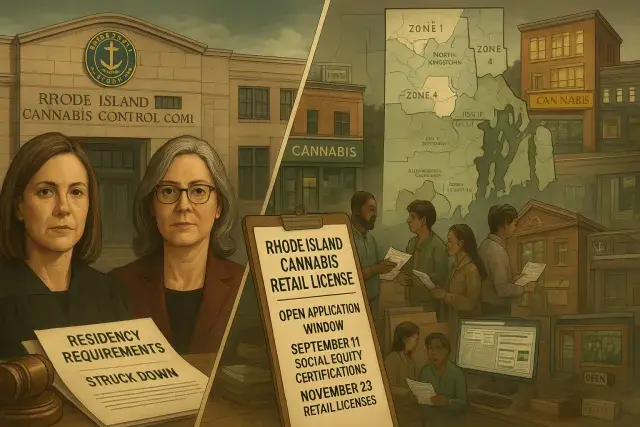
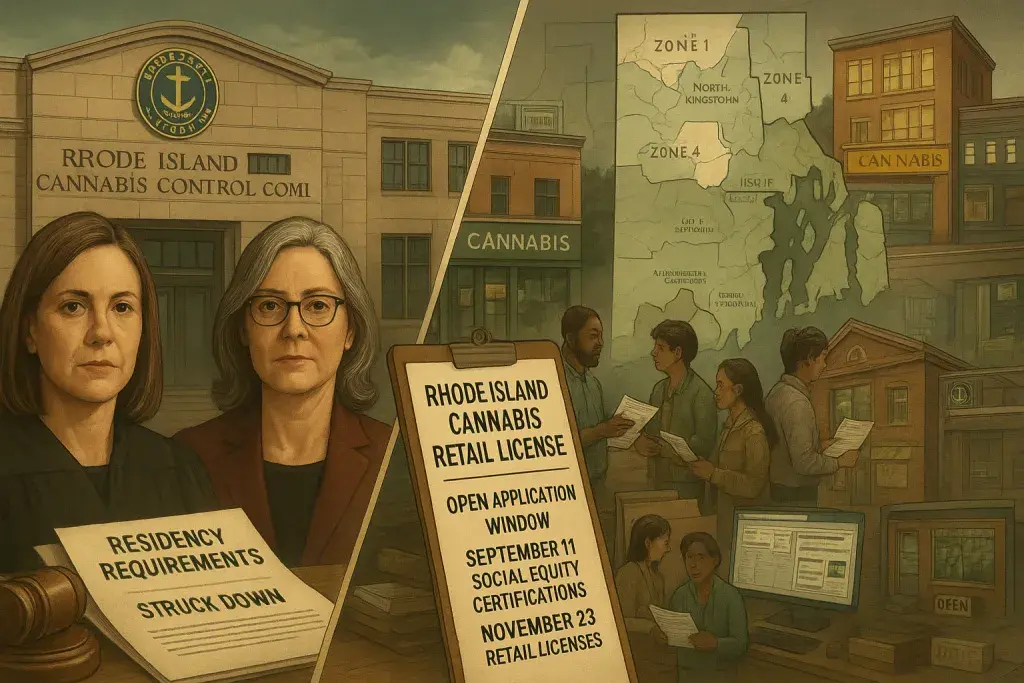
Rhode Island's cannabis retail licensing process is back in motion after a federal court effectively scrapped it in April. The Cannabis Control Commission is reopening both social equity certifications and general retail applications, restarting a process that regulators had already tried to push through once despite repeated warnings from courts in other states that residency-based licensing rules don't hold up constitutionally.
The mechanics matter here. Social equity certification applications are due September 11, while retail cannabis license applications remain open through November 23. Operators building out compliance files during this window, whether they're finalizing lease documentation, zoning approvals, or seed-to-sale tracking integrations ahead of launch, are also rethinking their technology stack. Multi-location operators watching Rhode Island's reset often look to comparable markets for infrastructure decisions; a dispensary pos system Minnesota deployment, for instance, offers a useful reference point for how point-of-sale platforms handle METRC reporting and inventory reconciliation across a growing license base. dispensary pos system Minnesota
The underlying problem was straightforward, if avoidable. Rhode Island's original social equity framework required at least one applicant to be a state resident. Federal courts elsewhere had already struck down similar residency mandates as unconstitutional barriers to interstate commerce, and Judge Melissa DuBose didn't mince words about the commission moving forward anyway. She called the resulting fallout "self-inflicted." The commission, chaired at the time by Kim Ahern, now a candidate for attorney general, pressed ahead despite the legal exposure. When the challenge succeeded, every application and every social equity certification already submitted was voided. The General Assembly then had sixty days to rewrite the statute and direct the commission to stand up a new process, which is what's happening now.
What Changed Beyond Residency
Lawmakers didn't stop at removing the explicit residency requirement. They also pared back several implicit residency conditions embedded in the social equity application criteria, broadening who can qualify. That's a meaningful shift for out-of-state investors and multi-state operators eyeing Rhode Island's market, though it also raises fairness questions that operators on the ground are voicing loudly.
Here's the catch: applicants who have held real estate and paid rent on properties for years, specifically to satisfy zoning and site-control requirements for the license lottery, now compete against brand-new applicants with no such sunk costs. Existing hopefuls have been bleeding cash on leases for space they may never open, all while waiting on a lottery draw that keeps getting delayed. The new process, however necessary legally, doesn't erase that financial asymmetry.
Supply Chain Pressure Building Underneath
The license freeze has consequences beyond paperwork. Rhode Island currently has nine operating dispensaries against 55 licensed cultivators, down from 58 earlier this year. OP Pharm, LLC merged into a vertically integrated compassion center, New Leaf, and Blackstone Valley Group simply didn't renew its license. Six of the nine dispensaries are partially or fully vertically integrated, meaning they grow their own product and buy less wholesale flower from independent cultivators. That's a shrinking customer base for growers who were already competing hard on wholesale pricing.
The state approved 24 licenses spread across six zones, but the canceled lottery would have only awarded 20, since Zone 1 in the north and Zone 4, covering East Greenwich, North Kingstown, Cranston, and Warwick, didn't draw enough applicants. Before the derailment, the commission was reportedly considering slowing licensing further, worried that opening too many stores too fast would trigger price compression among the nine existing dispensaries. Cultivators, unsurprisingly, see it the opposite way. Fewer retail doors means fewer buyers for their compliant, lab-tested product, and margins that were already thin under the state's excise tax structure get thinner.
What Operators Should Watch Now
- Certification and application deadlines are tight, and documentation gaps could disqualify otherwise strong applicants.
- Real estate and zoning approval remain mandatory before the lottery, not after, so site control still needs to be locked down early.
- License types split across social equity, worker cooperative, and general retail categories, each with different qualifying criteria.
- Vertical integration among existing dispensaries continues to shrink wholesale demand for independent cultivators.
None of this resolves the tension between fixing a constitutional problem and protecting applicants who've been financially exposed for years. The reopened process gives Rhode Island a legally sound path forward. Whether it gives struggling cultivators and long-waiting applicants a fair one is a separate question entirely.