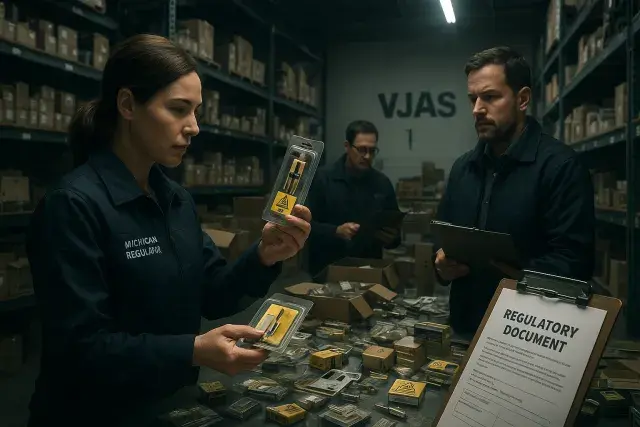
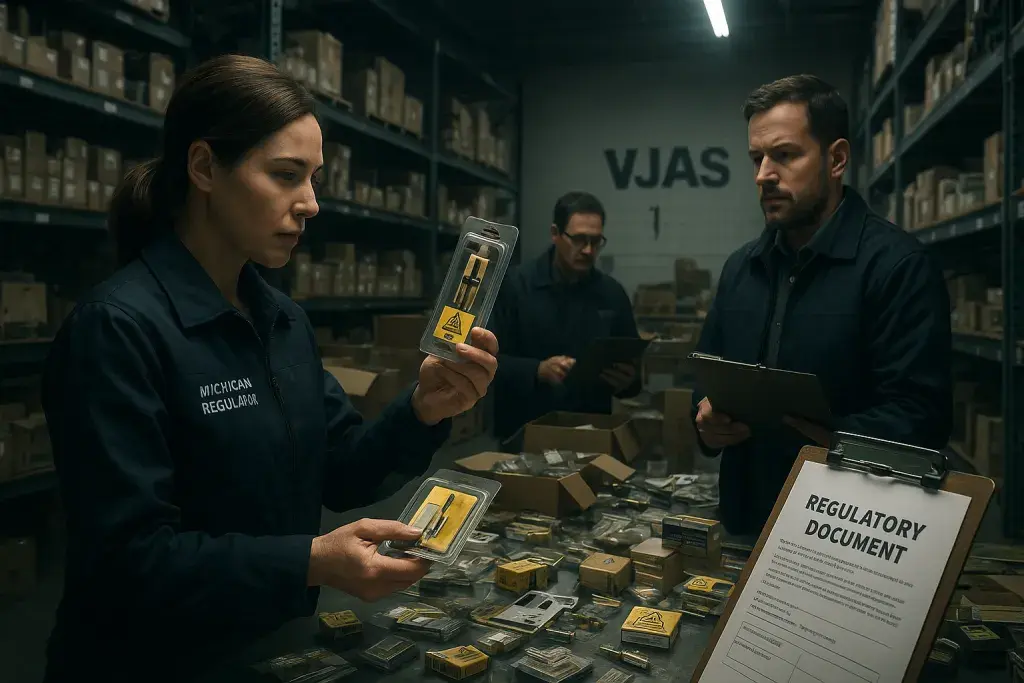
A Michigan cannabis processor is facing serious licensing consequences after state inspectors found more than 12,000 individual products with no Metrc tags or identifying information - including items in California-specific packaging - on the premises of its Harrison Township facility. The Michigan Cannabis Regulatory Agency filed a formal complaint against VJAS 1, accusing the licensee of holding untagged inventory that employees could not explain, as well as properly tagged products that, upon cross-referencing, were supposed to be located at other licensed businesses entirely. The CRA is now pursuing fines and potential suspension, revocation, restriction, or non-renewal of the company's license.
The scale of the alleged inventory irregularities is hard to dismiss as a bookkeeping slip. Seed-to-sale tracking systems like Metrc exist precisely to prevent this kind of opacity - every compliant product batch in Michigan's regulated market is supposed to carry a unique tag that ties it to a licensed cultivator, processor, or distributor within the state's chain of custody. That traceability is the regulatory spine of adult-use and medical cannabis commerce, and operators in adjacent states know it well; vendors of marijuana pos software nevada and other regulated markets build Metrc integration directly into their point-of-sale and inventory management platforms because tag reconciliation is a non-negotiable compliance function, not an optional feature. When products show up with California-specific warning language and "CA" branding in a Michigan facility, the absence of tags stops being an administrative curiosity and starts looking like something more deliberate.
What makes the tagged-product finding particularly damaging is that it compounds the untagged inventory problem rather than offsetting it. Investigators found a subset of products with valid Metrc tags - which might initially suggest partial compliance - but when those tags were cross-referenced against the state's tracking records, the products were registered as being at other licensed cannabis businesses. In plain terms, the tagged inventory didn't belong there either. That combination: thousands of untagged items, products in out-of-state packaging, and properly tagged products misallocated from other licensees, describes a supply chain situation that no credible internal miscommunication can fully account for.
Why Untagged Inventory Is Not a Gray Area in Regulated Cannabis
Regulated cannabis markets were designed from the start to eliminate the kind of inventory ambiguity that plagued illicit distribution. Metrc - used in Michigan and a growing number of state-licensed markets - assigns a radio-frequency identification tag to each plant and product batch, logging every transfer, sale, and disposal in a state-accessible database. Dispensaries, processors, and cultivators are all required to reconcile their physical inventory against that database on a regular basis. The system is deliberately difficult to work around undetected, which is exactly why enforcement agencies treat missing tags as a serious red flag rather than a clerical inconvenience.
For a processor specifically, the compliance stakes are high. Processors receive raw cannabis inputs from cultivators, transform them into finished products - concentrates, edibles, vape cartridges, and similar SKUs - and then distribute those products to licensed dispensaries for retail sale. Each step requires documented transfers within Metrc. Holding more than 12,000 untagged items in a processing facility is not a situation that develops by accident over a weekend; it represents either a sustained failure of internal compliance controls or something more troubling. The CRA's complaint makes clear that on-site employees were unable to provide any coherent explanation for the volume or origin of the untagged products, which removes the most generous possible interpretation.
The Out-of-State Packaging Detail Changes the Tenor of the Case
Cannabis is federally illegal, and interstate commerce in cannabis products - even between two adult-use states - remains prohibited under federal law. Michigan's regulatory framework, like every other state cannabis program, is built on the explicit assumption that licensed products originate within the state's own licensed supply chain. Discovering products in California-compliant packaging at a Michigan processing facility is not a minor labeling infraction; it raises questions about whether the products entered the facility through channels entirely outside Michigan's licensed market.
California's cannabis packaging requirements include specific warning language and formatting mandated by that state's regulations, which is why the "CA" designation would be visible and distinguishable to trained inspectors. Product manufactured and packaged for California retail sale is not compliant for Michigan retail sale - and it certainly shouldn't be sitting untagged in a Michigan processor's inventory without explanation. The consumer safety dimension here matters too: products that have not passed through Michigan's required testing and tagging protocols have no verified certificate of analysis tied to Michigan's lab standards. Whether or not the products were actually unsafe, the state has no way to make that determination - which is precisely why the compliance architecture exists.
What Licensed Operators Should Take From This Enforcement Action
Enforcement actions of this magnitude send a signal that reaches well beyond the named licensee. Michigan's CRA has shown a consistent willingness to pursue formal complaints and push toward license revocation when inspections reveal systemic rather than incidental compliance failures. For operators across the state - processors, dispensaries, and cultivators alike - this case is a reminder that Metrc reconciliation needs to be an operational priority, not a task deferred until the next audit cycle.
The tagged-products-at-wrong-locations finding is also worth attention for businesses that transfer inventory between licensed entities. Metrc transfers must be properly documented and received by the destination facility. If a transfer goes unacknowledged in the system, the tags remain associated with the originating business on paper - meaning another facility holding those products creates an immediate discrepancy that investigators can and do detect. Tightening transfer documentation procedures isn't regulatory theater; it's the difference between a clean inspection and a formal complaint.
VJAS 1 has not yet had its license suspended or revoked - the complaint initiates a formal process that may include hearings and the opportunity to respond. But the breadth of what inspectors found leaves the licensee with an exceptionally narrow path to a favorable outcome.