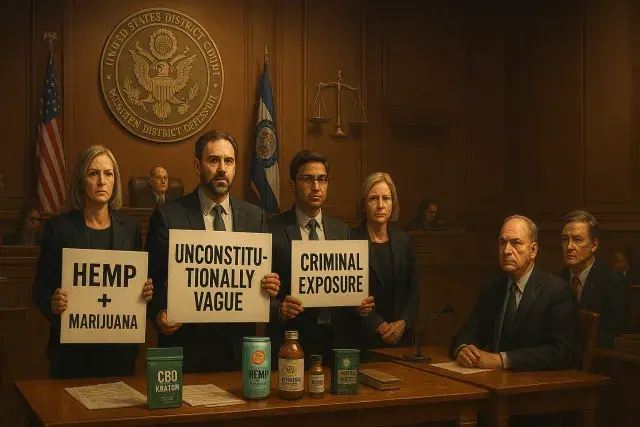
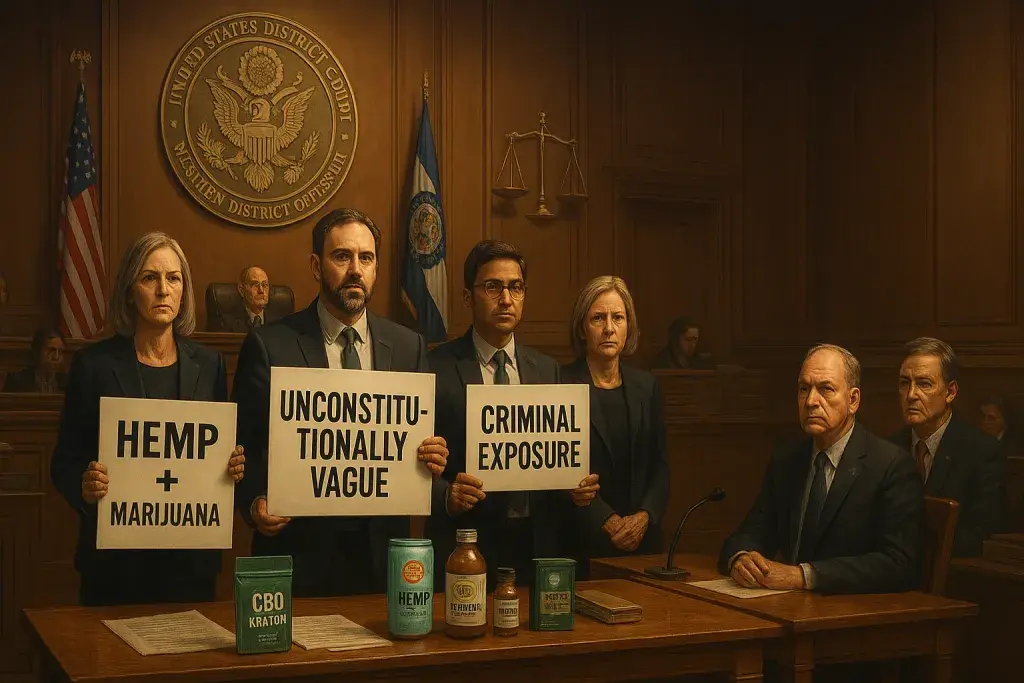
A coalition of hemp retailers, trade groups, and multistate operators filed a federal lawsuit Thursday targeting a Missouri law that would pull all intoxicating hemp products from store shelves beginning November 12. The suit, filed in the U.S. District Court for the Western District, argues that House Bill 2641 contains definitions so contradictory they render the law unconstitutionally vague - and that the consequences of that vagueness aren't merely commercial. They're criminal.
The plaintiffs include MNG 2005, Inc., the St. Louis-based parent company behind 55 CBD Kratom retail locations nationwide, the Missouri Hemp Trade Association, and Wisconsin-based hemp manufacturer Lifted Liquids Inc. Their central argument is specific: the bill defines certain products as both "hemp" and "marijuana" in different provisions, leaving businesses, law enforcement, and prosecutors with no coherent legal standard to apply. That kind of definitional chaos creates real operational exposure - something operators in licensed markets elsewhere understand well. Retailers relying on compliant point-of-sale systems and inventory tracking (the way, for instance, cannabis pos new york operators manage product classification and age-gating) depend on statutory definitions being consistent to maintain compliant records. When the definitions themselves contradict, the compliance infrastructure has nothing solid to stand on.
Craig Katz, government relations and compliance manager for MNG, put it plainly: "A lot of this stuff is kind of in the weeds. It's very difficult to understand. And when people are trying to legislate it, if they don't understand it, you come up with something like HB2641, which doesn't make a whole heck of a lot of sense." That's not just frustration talking. From a compliance standpoint, businesses can't build internal controls around a statute that doesn't hold together internally.
What the Law Actually Does - and Why That's the Problem
HB2641 was among the first bills signed by Missouri Gov. Mike Kehoe this year. On its face, it aligns state law with the federal hemp ban Congress approved last year - pulling intoxicating hemp products off general retail shelves and, if Congress allows such products at all going forward, restricting sales exclusively to licensed marijuana dispensaries. THC seltzers currently sold in grocery stores and bars would come down November 12. Products with as much as 1,000 mg of THC currently sold in smoke shops - outside the licensed dispensary channel - would also be prohibited.
Here's the catch: the law's structure creates a compliance target that moves based on federal action, and the effective-date provisions are, in the coalition's words, "so convoluted that businesses cannot determine which products are covered or when." That's not a minor drafting inconvenience. For operators managing SKU catalogs, wholesale purchase orders, and inventory drawdown timelines, ambiguity about which products are covered and on what date translates directly into financial exposure. Do you stop ordering now? Do you return existing stock? Do you hold and risk enforcement? The law, as written, apparently doesn't answer those questions cleanly.
The coalition also flags an interstate commerce issue. While the bill purports not to interfere with interstate hemp commerce - a constitutionally sensitive area - it simultaneously restricts who may transport hemp products through Missouri. That's a tension the lawsuit will presumably ask the court to resolve.
The Criminal Exposure Angle Is the Sharpest Edge Here
Most compliance disputes in cannabis retail carry regulatory risk: license suspension, administrative fines, product holds. This one carries something heavier. Because unlicensed marijuana activity is a crime under Missouri law, a business selling something the statute categorizes as marijuana - even if that same statute elsewhere categorizes it as hemp - could theoretically face criminal exposure. The coalition made that explicit in its announcement.
That's not a hypothetical industry concern. It's a structural problem the legislature created by writing conflicting definitions into the same bill. Rep. Dave Hinman, the bill's Republican sponsor from O'Fallon, framed the lawsuit as a last-ditch effort by the hemp industry and expressed confidence the law would hold up. "HB2641 passed the Missouri House, Senate and was signed by the governor," he said. "It was vetted throughout the entire process." Fair enough as a procedural argument - but vetting a process doesn't guarantee coherent statutory language, and courts evaluate the text, not the legislative calendar.
Enforcement authority under the bill falls to Missouri Attorney General Catherine Hanaway, who is named as a defendant alongside Gov. Kehoe and Sarah Wilson, director of the Missouri Department of Health and Senior Services. Hanaway's office said it had not been served the lawsuit. Kehoe's office and DHSS declined to comment, citing pending litigation.
The Broader Implication: A Forced Channel Shift With an Unresolved Legal Foundation
Set aside the constitutional arguments for a moment. The practical market implication of HB2641 - if it survives - is a mandatory channel migration. Products currently sold in general retail would move exclusively into the licensed dispensary channel, or disappear entirely. That's a significant structural shift for brands, distributors, and retailers operating in the hemp space. It's also, as Missouri Hemp Trade Association President Jay Patel noted, a consolidation of market access that benefits one class of license holder. "This isn't consumer protection," Patel said. "It's the elimination of an entire legal industry coupled with a government-mandated monopoly."
Whether or not that characterization survives legal scrutiny, the underlying dynamic is real. States that funnel intoxicating cannabinoid products exclusively through licensed dispensaries concentrate purchasing power, compliance burden, and consumer traffic in ways that reshape the competitive structure of the entire market. Dispensary operators may welcome the business. Hemp brands that built their distribution through general retail - grocery, convenience, bars - face a fundamentally different commercial reality.
The November 12 effective date is weeks away. The court's response to any motion for a preliminary injunction will determine whether Missouri's hemp retailers have any operational runway left - or whether they're already winding down inventory they may no longer legally sell.