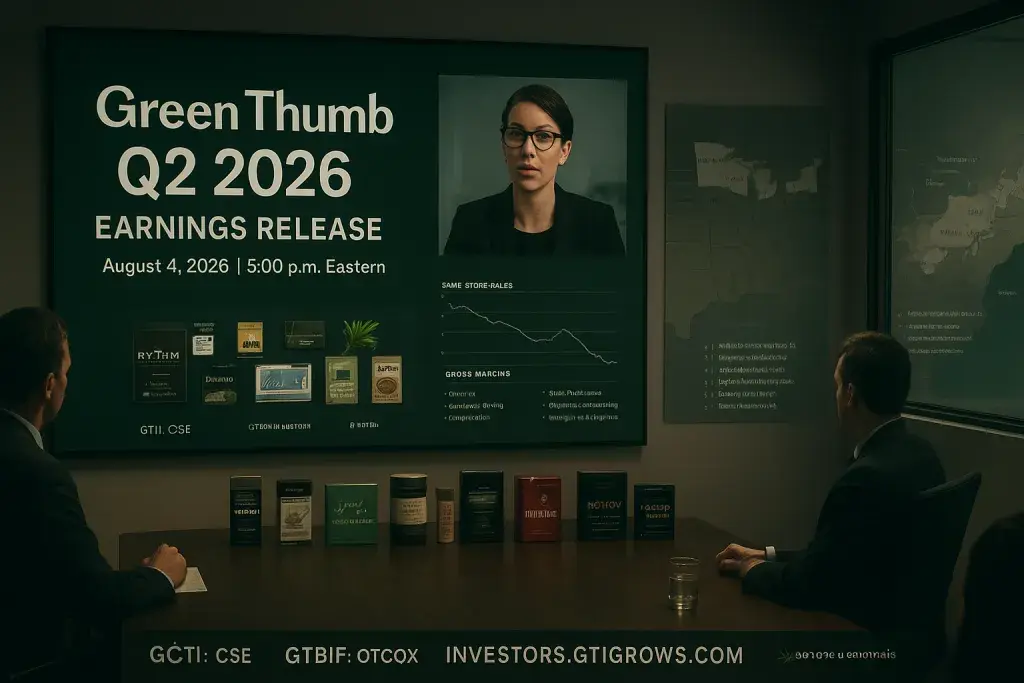
Green Thumb Industries, one of the largest vertically integrated cannabis operators in the United States, will report its second quarter 2026 financial results after market close on August 4, 2026, followed by a live conference call and webcast at 5:00 p.m. Eastern Time. The announcement confirms a reporting cadence that investors and wholesale partners tracking the multi-state operator (MSO) space have come to watch closely. For a company operating manufacturing facilities and RISE Dispensaries across 14 U.S. markets with roughly 4,800 employees, a quarterly earnings release carries weight well beyond the balance sheet.
Green Thumb's footprint spans both adult-use and medical cannabis markets, which means its results tend to reflect broader pressures on licensed retail operators - pricing compression at the wholesale level, excise tax burdens, state-by-state regulatory variation, and the ongoing grind of 280E federal tax exposure that continues to hit cannabis businesses without the deductions available to conventional retailers. For operators thinking about how technology stacks hold up across multi-jurisdiction compliance demands - including, for instance, operators evaluating compliant cannabis POS in New York - the way a scaled MSO like Green Thumb manages its retail infrastructure offers a useful reference point for what enterprise-level compliance and inventory management actually requires.
The company's brand portfolio - RYTHM, Dogwalkers, incredibles, Beboe, &Shine, Doctor Solomon's, and Good Green - represents a SKU mix that sits across multiple price tiers and product categories, from flower and pre-rolls to edibles and infused formats. Managing that range across state-specific packaging and labeling requirements, batch-level lab testing documentation, and wholesale distribution agreements is operationally intensive work. How well Green Thumb executes on that complexity will almost certainly surface in its Q2 numbers.
What Investors and Operators Will Be Watching
For institutional investors and industry observers alike, the Q2 report arrives at a moment when the U.S. cannabis industry is still absorbing the effects of persistent federal scheduling uncertainty, uneven state-level tax reform, and margin pressure across both wholesale and retail channels. Green Thumb has historically positioned itself as a financially disciplined operator - one of the few MSOs to have reported consistent profitability at various points - so any shift in that narrative will draw scrutiny.
Retail same-store sales performance will matter. So will gross margin trends in the branded goods segment, where wholesale pricing in mature markets has been under sustained downward pressure as cultivator oversupply works through the system in states like Illinois, Pennsylvania, and others where Green Thumb operates. The company's ability to protect margin through brand positioning rather than price-cutting has been a stated strategy; Q2 results will test whether that holds.
Dispensary-level economics are also worth watching. Running a high-volume retail cannabis store involves costs that non-cannabis retailers don't carry in the same way - armored cash logistics, METRC compliance staffing, seed-to-sale tracking systems, and the compliance overhead of managing age-verification protocols across budroom transactions. Those costs don't compress easily, and in states where adult-use tax rates remain high, they put real pressure on store-level margin.
How Multi-State Scale Changes the Compliance Equation
Here's the thing about operating across 14 markets simultaneously: there is no single compliance standard. Each state runs its own seed-to-sale tracking system, sets its own product testing requirements, and enforces its own packaging rules. Illinois uses one framework; Ohio another; Pennsylvania another still. A brand like RYTHM sold at a RISE Dispensary in Chicago must meet different certificate-of-analysis documentation requirements than the same product sold in a different state. That's not a theoretical concern - it's a daily operational reality for procurement, compliance, and retail staff.
Multi-state operators of Green Thumb's scale typically invest heavily in centralized compliance infrastructure to manage this, including enterprise-level POS systems integrated with state-mandated tracking platforms, SKU-level inventory management, and legal teams that monitor regulatory updates across every licensed market. Smaller independent dispensaries watching how MSOs handle this complexity often find that the gap isn't just financial - it's organizational. The reporting structures, the technology integrations, the compliance logs - all of it scales differently at 14 markets versus one or two.
Conference Call Details and Access
The August 4 conference call is open to registered participants via a live dial-in link provided by Green Thumb, with a simultaneous audio webcast available. An archived version of the webcast will be posted to the company's investor relations page at investors.gtigrows.com. Analyst questions during the call typically cover segment performance, capital allocation, state-level market dynamics, and management's read on the regulatory environment - all of which carry downstream relevance for suppliers, wholesale partners, and dispensary technology vendors that track MSO strategy as a leading indicator of where the broader licensed market is heading.
For investors holding positions in Green Thumb via its CSE listing under GTII or its OTCQX listing under GTBIF, the August 4 date now anchors the near-term calendar. For everyone else paying attention to the cannabis business - operators, brands, vendors, landlords, and compliance professionals - the numbers that follow will offer another data point on where licensed retail actually stands heading into the back half of 2026.