Sustained operator confidence in regulated cannabis markets tends to surface in one predictable place: workforce investment. When licensed dispensaries feel stable enough to develop staff over the long term rather than simply fill positions, it signals something meaningful about the underlying health of the business. That shift is becoming more visible across several adult-use markets, and it carries real operational implications for retailers managing tight margins, compliance obligations, and fluctuating consumer demand.
The mechanics here matter. Dispensary operators who commit to structured staff development - budtender training, compliance certification, inventory management fluency - report fewer errors in seed-to-sale tracking and lower rates of inventory shrinkage. Those outcomes feed directly into audit performance and licensing renewals. Point-of-sale systems that integrate staff accountability features have become part of this picture; operators working with solutions built specifically for regulated retail, like their platform designed for the Oregon market, are finding that compliance workflows and staff training documentation can sit within the same operational stack rather than running on separate, disconnected systems.
Here's the catch, though. Staff retention in cannabis retail remains structurally difficult. Compensation benchmarks in the sector lag behind comparable retail roles in other industries, and the compliance demands placed on frontline employees - age verification protocols, purchase limit enforcement, compliant packaging confirmation at point of sale - add responsibility without always adding pay. Operators who invest in training a budtender for six months and then lose them to a competing dispensary or an unrelated retail employer are absorbing a real cost that rarely shows up cleanly in a P&L.
Compliance Pressure Sits Directly on Frontline Staff
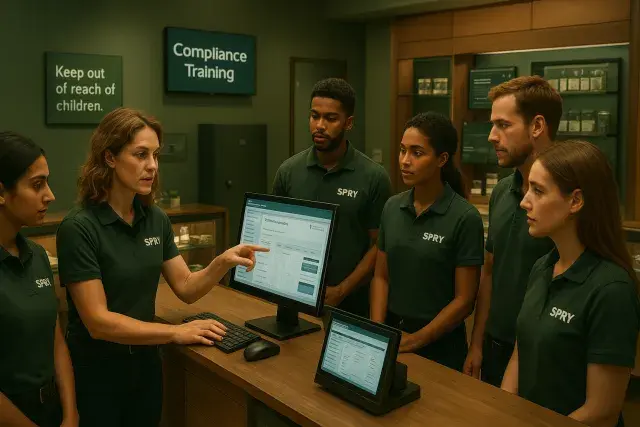
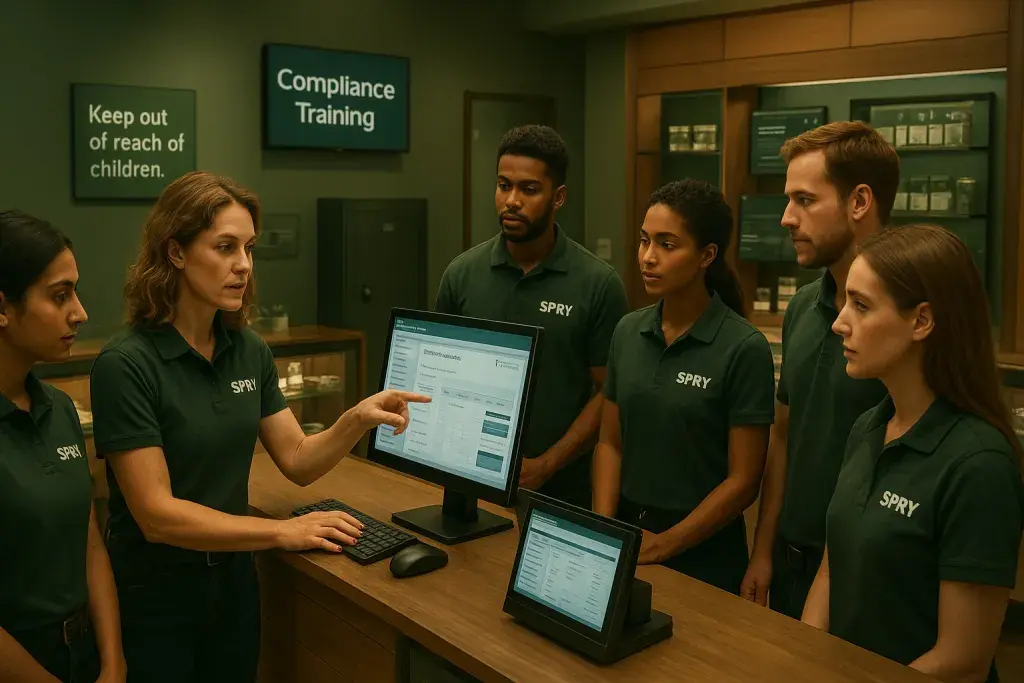
What's striking is how much of a dispensary's regulatory exposure sits with its least senior employees. A budtender who misses an ID check, fails to log a transaction correctly in METRC, or hands over a product without confirming the COA is available can generate a compliance violation that affects the license holder - the owner, not the employee. That asymmetry of risk shapes how thoughtful operators approach training. It is not simply about customer service or sales floor performance. It is about making sure every person at a POS terminal understands exactly what a compliant transaction looks like and why the documentation trail exists.
Multi-state operators tend to formalize this more rigorously than single-location independents, partly because they have the scale to build internal compliance programs and partly because a violation in one state can draw regulatory attention across their entire license portfolio. Smaller operators face the same underlying exposure with fewer resources to manage it. The operational gap between those two groups continues to widen in markets where license caps have been lifted and competition for retail traffic has intensified.
Investment in People as a Licensing Strategy
Some operators have started framing staff development explicitly as a licensing and compliance strategy rather than a pure HR function. The logic is straightforward: regulators in adult-use markets are paying attention to whether licensed retailers demonstrate operational maturity. Documented training programs, consistent compliance logs, and low error rates in seed-to-sale reporting are the kind of evidence that supports a clean renewal and, in some jurisdictions, a favorable outcome during an inspection.
To put it plainly - a well-trained team is a compliance asset. That framing changes how operators budget for training. It moves the line item from discretionary overhead toward something closer to a licensing cost, which is where it arguably belongs. In markets where excise tax obligations and 280E exposure already compress margins, operators need every operational efficiency they can find. Reducing compliance errors through consistent staff development is one of the more direct ways to protect the bottom line without touching the wholesale menu or repricing SKUs.
The dispensaries building durable operations right now are not necessarily the ones with the flashiest retail buildout or the deepest product selection. They are the ones treating their teams - and the systems those teams use - as core infrastructure.